61 vs 88 keys piano: which keyboard should you choose to learn chords?
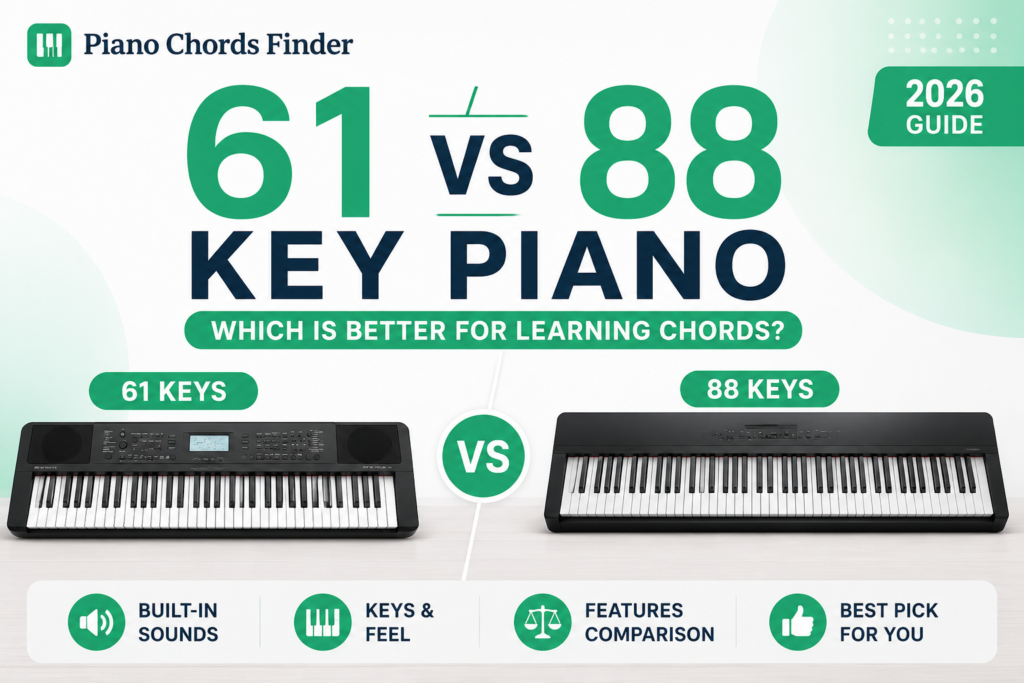
If you’re starting to learn piano chords, one of the first decisions you’ll face is choosing between a 61-key keyboard and an 88-key digital piano.
The difference is not just the number of keys — it directly affects:
- How you learn chords
- How comfortable you feel playing
- How far you can progress
What is the real difference between 61 and 88 keys?
- 61-key keyboards → ~5 octaves
- 88-key pianos → full piano range (7+ octaves)
👉 Why it matters:
- 61 keys = enough for most chords and beginner songs
- 88 keys = necessary for full piano technique and advanced playing
61-key keyboards (with built-in sounds)
These are standalone keyboards, meaning they:
- Have built-in sounds (piano, strings, etc.)
- Do NOT require a computer
- Are ideal for beginners
When 61 keys are a good choice
Choose a 61-key keyboard if:
- You are a complete beginner
- You want something affordable
- You mainly want to learn chords and simple songs
👉 Advantages:
- Lower price
- Portable
- Easy to start
👉 Limitations:
- No weighted keys (in most models)
- Limited range
Best 61-key keyboard on Amazon (with sounds)
Yamaha PSR-E373
👉 Why this is a top choice:
- High-quality Yamaha piano sounds
- Touch-sensitive keys (important for dynamics)
- Built-in learning modes
👉 Best for:
- Beginners learning chords
- Home practice
88-key digital pianos (with realistic feel)
These are designed to replicate an acoustic piano.
When 88 keys are the better choice
Choose 88 keys if:
- You want to learn piano properly
- You plan to progress long-term
- You want realistic touch and feel
👉 Advantages:
- Full range
- Better for technique
- Weighted keys simulate real piano
👉 Downsides:
- More expensive
- Less portable
Best 88-key digital piano on Amazon
Alesis Recital 88-Key Digital Piano
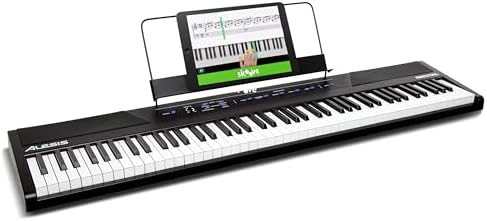
- An Electric Piano That’s Tailored to You – Feature-packed Electric keyboard with 88 premium full-sized semi weighted key…
- Premium Sounds – 5 voices (Acoustic Piano, Electric Piano, Organ, Synth, and Bass), built-in FX – Chorus, Reverb, and tw…
- All The Right Connections – 1/4″ sustain pedal input (pedal not included), 1/4″ stereo headphone output for private prac…
👉 Why it’s a great option:
- 88 full-size keys
- Built-in speakers
- Simple and beginner-friendly
👉 Best for:
- Learning chords with both hands
- Building real piano technique
Product comparison
| Feature | Yamaha PSR-E373 | Alesis Recital |
|---|---|---|
| Keys | 61 | 88 |
| Sound | Built-in | Built-in |
| Key type | Touch-sensitive | Semi-weighted |
| Portability | High | Medium |
| Best for | Beginners | Long-term learning |
| Price | Lower | Medium |
Which is better for learning chords?
👉 If your goal is:
Learning chords quickly and playing songs
→ Choose a 61-key keyboard
Learning proper piano technique and using both hands fully
→ Choose an 88-key digital piano
Real recommendation (important)
👉 If you’re unsure:
- Start with a 61-key keyboard
- Upgrade later to 88 keys
👉 If you already know you’re serious:
- Go straight to 88 keys
What features matter more than keys?
Don’t just look at the number of keys. Focus on:
- Touch sensitivity (critical)
- Sound quality
- Build quality
- Ease of use
👉 A good 61-key keyboard is better than a bad 88-key piano.
Common beginner mistake
Buying:
- A cheap keyboard without touch sensitivity
👉 This slows your learning and makes chords sound flat.
Final verdict
Yamaha PSR-E373 (61 keys)
Yamaha PSR-E373 61-Key Keyboard · 259,00 € · 4,8
Top-selling beginner keyboard with hundreds of sounds and learning features. Best for starting fast.
Alesis Recital 88 (88 keys)
Alesis Recital 88-Key Digital Piano · 259,99 € · 4,8
Affordable 88-key digital piano with built-in speakers and realistic playing range. Best for long-term progress.
Product comparison (61 vs 88 keys keyboards)
| Feature | Yamaha PSR-E373 61-Key Keyboard | Alesis Recital 88-Key Digital Piano |
|---|---|---|
| Number of keys | 61 | 88 |
| Type | Portable keyboard | Digital piano |
| Built-in sounds | ~622 voices | ~10 voices (focused on piano) |
| Polyphony | 48 notes | 128 notes (typical for this model range) |
| Touch sensitivity | Yes | Yes |
| Key action | Synth-action | Semi-weighted |
| Built-in speakers | Yes | Yes |
| Learning features | Yes (lesson modes) | Basic |
| Accompaniment styles | Yes | No |
| Portability | Very high (lightweight) | Medium |
| Best use | Chords, pop, beginners | Piano learning, technique |
| Price range | Lower | Medium |
Conclusion
Both options work for learning chords — but they serve different goals.
- Casual learning → 61 keys
- Serious piano learning → 88 keys
👉 The most important thing is to start and practice consistently.